


By Emma Janzen
In 1989, author and sociologist Ray Oldenburg classified bars, restaurants, cafés, bookstores, salons, and other gathering spots as “third places,” or locations outside of the home and workplace that prove essential to the wellbeing of communities. These social spaces—bars and restaurants in particular—stand as some of the pillars of modern society. Within their walls, ideas and meaningful connections spark and flourish.
The people who build and sustain these institutions are nothing short of vital to our culture. And yet, despite the important roles that bartenders, bar owners, restaurateurs, dishwashers, servers, and others hold in our society, many face challenging working conditions and unpredictable incomes. Among other significant roadblocks that exist, outdated federal systems like the tipped wage credit, which allows businesses to pay tipped employees an hourly wage far below the national average (at $2.13 an hour), can hinder the viability of long-term, sustainable careers in hospitality.
While many bars and restaurants are working to improve workplace culture and compensation, many mainstream narratives suggest there’s no clear fix for the system’s inequities. This view is limited, though, which is why in 2021, the Tales of the Cocktail Foundation launched a policy initiative to challenge the status quo. What began as a response to the pandemic’s impact on bars and bartenders evolved into a three-year research project exploring the hospitality industry’s labor landscape. As part of the study, bartenders and bar owners shared insights on the job’s biggest pros and cons, including views on the subminimum wage and possible alternatives.
“Policies and decisions around how hospitality workers earn their wage affects millions of people in the U.S., which makes this such an important and time-sensitive conversation to have,” says Tales of the Cocktail Foundation executive director Charlotte Voisey, noting how the conversations from this project led to a multi-faceted policy action plan outlining pathways toward a more equitable future. “New solutions have been identified for a stronger economic situation for bar owners as well as their staff—these new models need to be discussed, the implications fully understood and considered.”
Last July, the keynote presentation at the annual Tales of the Cocktail conference offered a preview of this study, and now, the Foundation is releasing the full results and asking the industry to get involved. “Supporting an industry that has been historically underserved—from lack of industry research, common resources to educate and inform, and funding for coalitions—is crucial in breaking the cycles that have made it difficult, if not impossible, to build a lifelong career in hospitality,” says Eileen Wayner, Tales of the Cocktail Foundation CEO. This policy initiative, they say, is the first step towards meaningful change.
The Study
Helmed by the Tales of the Cocktail Foundation, this study was completed with oversight and assistance from a volunteer committee including: Alex Jump from Focus on Health, Amanda Gunderson from Another Round Another Rally, Zen Castro of Espíritu Mezcaleria and BeachBum Berry’s Latitude 29, Robin Nance of Speed Rack, Kaiden Hope and Jesse Maguire from Beam Suntory, Lauren Darnell of Strongward, Lynnette Marrero of Speed Rack, and John Reyna, Managing Attorney with Texas Hospitality & Non-Profit Law Center.
Together with internal government affairs manager Tammera Catchings, and with support from the Florida International University Chapman School of Hospitality, the project unfolded in two phases: first, a survey of bartenders and servers from around the country. Second, to ensure that both management and staff perspectives were represented, a survey of bar owners and restaurateurs was also conducted. “The impetus for this study was to get a holistic perspective,” says program director Lola Thomas. Key areas of study included: labor costs and management, job satisfaction and concerns, and perspectives on tipping practices and policies, particularly those surrounding the subminimum wage and tipped wage credit.
“The hospitality industry is an ecosystem that is interconnected, but also with different individual challenges and opportunities. It was critical to get input directly from bar owners and bartenders to understand where challenges overlapped and also differed,” says Wayner. “This study acknowledges that there is not a one-size fits all approach or solution, but rather informed options to explore fully and a need for dialogue and shared solutions.”
Bartenders and Servers
More than 500 bartenders and servers from across the United States participated in the first survey. More than 60% of respondents received tips at their place of employment, and the interviewees came from states that offer high ($8/hour), medium ($3-8/hour) and low (under $3/hour) minimum wages.
An overwhelming percentage of bartenders (94%) and bar managers (96%) claimed to feel satisfied with their job. Eight out of ten do not work outside of the bar, and almost three-quarters of surveyees view service as their main career and not a stepping stone towards something else, as bartending is often portrayed in pop culture. Some of the most-repeated benefits of the job include: serving others, flexible schedule, non-traditional hours, good money, creative work, and social perks.
The biggest drawbacks? Rude customers, poorly trained managers, and inconsistent working hours were all mentioned, though the primary complaints for bartenders center on the lack of benefits such as paid vacation, health insurance, retirement plans, and other support systems.
83% of workers across different states and job types also agreed that raising the federal minimum wage would increase their job satisfaction. This is key to the TOTCF Policy Initiative, because it underscores the need to reevaluate the current system. Right now, under the tipped wage credit, employers can pay as little as $2.13 an hour, with the expectation that tips will raise earnings to the federal minimum of $7.25 (as of 2024). This rate, unchanged since 1991, is significantly outdated; While the standard minimum wage has risen over the years, the tipped wage has remained frozen, leaving hospitality workers underpaid for more than three decades compared to workers in other industries.
For bar workers, this makes it difficult to maintain a lifelong career in the hospitality industry. Tipped wages are unpredictable from week to week—and not guaranteed or consistent over time, as they are largely determined by the season, customer behavior, and systemic racism and discrimination, instead of employee performance—and fluctuating paychecks makes budgeting, investing, and securing basic needs such as housing and transportation difficult, if not impossible. In fact, research from the Economic Policy Institute reveals that employees in low-tip environments are more likely to experience poverty and financial instability, and as the Institute for Women’s Policy Research notes, “the tipped minimum wage disproportionately harms women, particularly women of color, jeopardizing their financial security and ability to lift themselves out of poverty.”
From the surveys conducted, 60% of bartenders said they felt satisfied with their pay, but the majority also support increasing the minimum tipped wage, albeit with a handful of commonly recurring concerns. Some worry that raising wages would eliminate tips altogether, which would negatively impact overall earnings. Others who work for independent businesses (i.e. not major chains), worry the bar or restaurant would not be able to make up the extra money needed to raise wages—labor already typically demands 30% of expenses—or that menu costs would go up to compensate for the change, which could force closures or encourage guests to take their business elsewhere. All reasonable question marks for an industry operating on precariously thin margins.
Bar Owners and Restaurateurs
To round out a complete picture of the complexities of the conversation, 182 bar and restaurant owners were also surveyed, including participants who currently use the tip credit, others who do not use it (despite operating in a state where it is allowed), and still others who own businesses in states where the tipped wage is prohibited. Respondents came from businesses of various sizes, in urban and suburban locations, in Florida, North Carolina, Texas, Louisiana, Arizona, Illinois, and New York (where the tip credit is being phased out) and California and Oregon (the latter two where the credit was banned in 1972).
These bar owners almost universally agreed that they would like to pay employees a more sustainable and predictable living wage, while acknowledging the same handful of concerns and difficulties bartenders and servers noted in their responses. The National Restaurant Association reiterates these concerns in a 2024 policy brief, adding how if the tipped wage credit is eliminated, bars and restaurants will be forced to raise menu prices, implement service fees, reduce the number of hours that employees work, or cut jobs outright.
Yet according to the findings of the TOTCF surveys, most business owners believe that the increased costs (and headaches) associated with eliminating the tipped wage credit are worth navigating, because the benefits outweigh the costs. In addition to generating higher employee retention, satisfaction, and loyalty—which are all good for the business’ bottom line—many operators said it was simply “the right thing to do,” writes Lisa Cain in the Journal of Hospitality and Tourism Management.
Alternative Models To The Tipped Credit
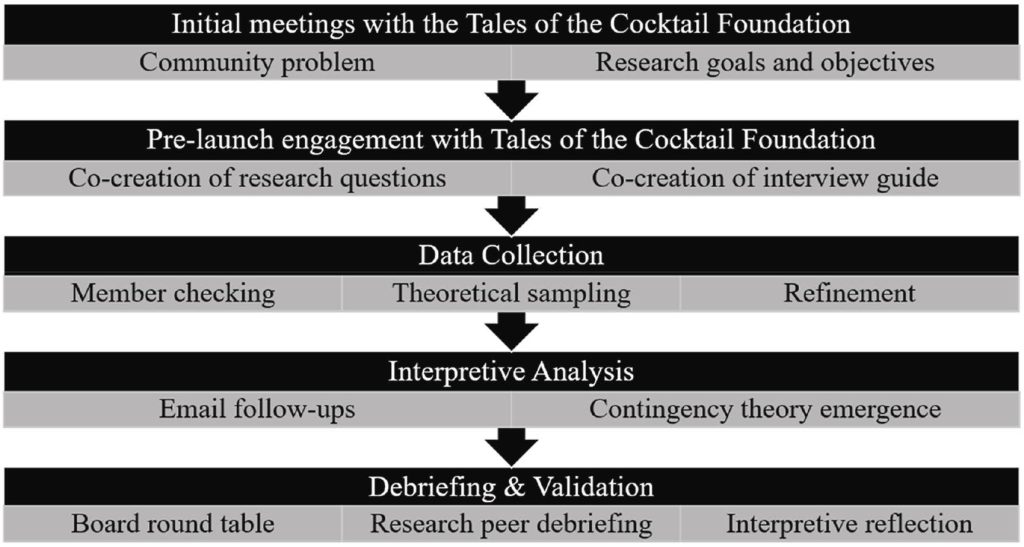
As the final stage of this policy initiative, the academic researchers at FIU Chapman School of Hospitality together with the Tales of the Cocktail Foundation published the peer-reviewed academic study Beyond the tip credit: Modernizing business models for equitable wage practices. They interviewed 13 additional bar owners and restaurant operators via zoom, from states operating with and without the tip credit, to glean more information about how they are testing out new systems to remain profitable while increasing base wages. From these conversations, six different models emerged.
In every business, tips were still present, and service charges were used (when legal). “The goal of these models is not to take tips away entirely, but rather explore systems that would make a higher minimum wage more viable in the long-run, so that tips make even more of a positive impact for employees as business owners continue on the road towards a better guaranteed minimum income,” explains Thomas.
“There is no one-size-fits-all model that will work,” Thomas adds. Each approach must be tailored to the unique circumstances of each place, taking into consideration customer expectations, market competition, state wage regulations, technology, business size, local culture, economic fluctuations, and team dynamics. Sometimes, an owner would adopt several of the models in tandem to stitch together an even stronger system for staying profitable while also retaining employees.
Table 1. Contextual business models for equitable wage practices results. From Beyond the tip credit: Modernizing business models for equitable wage practices.
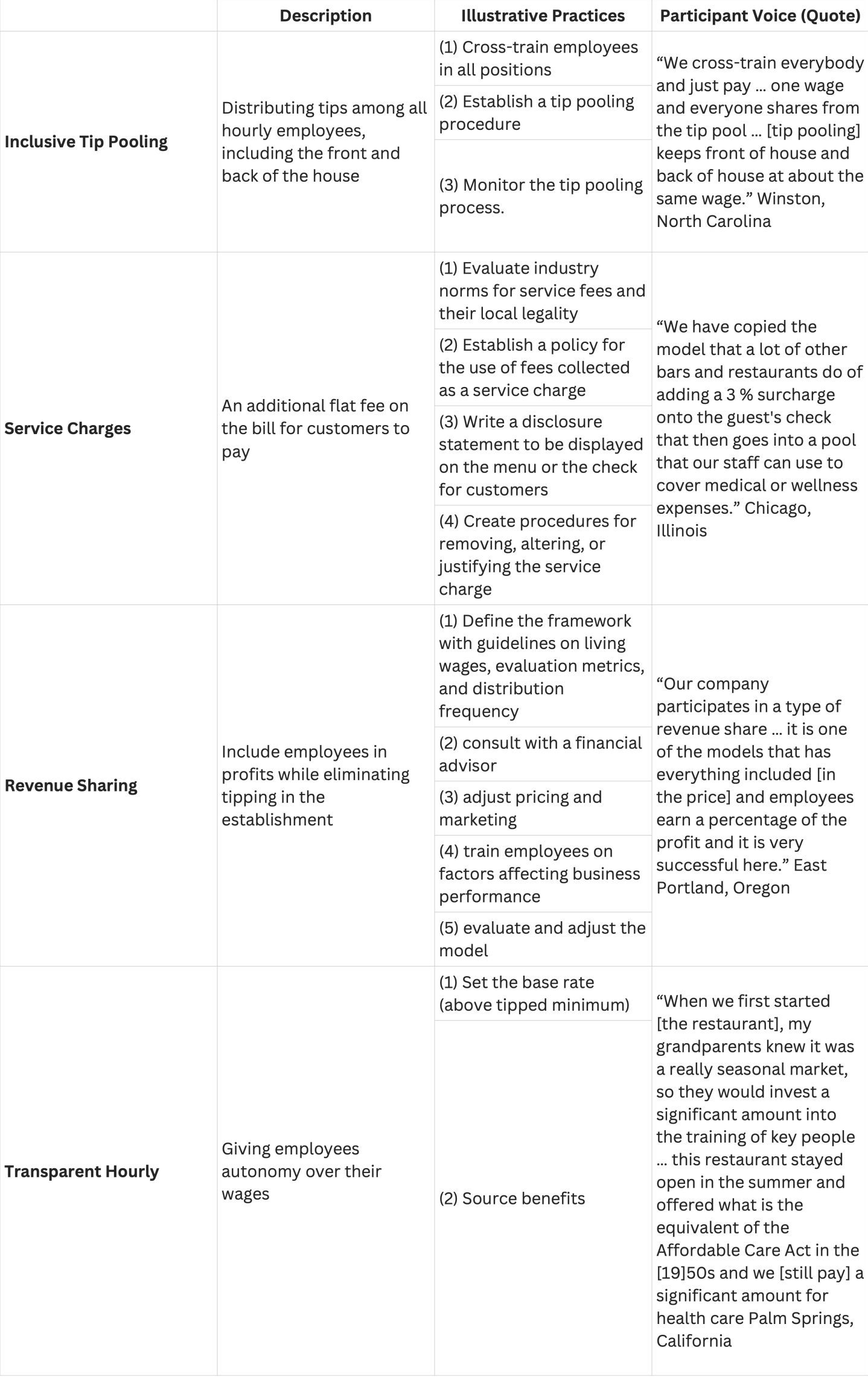
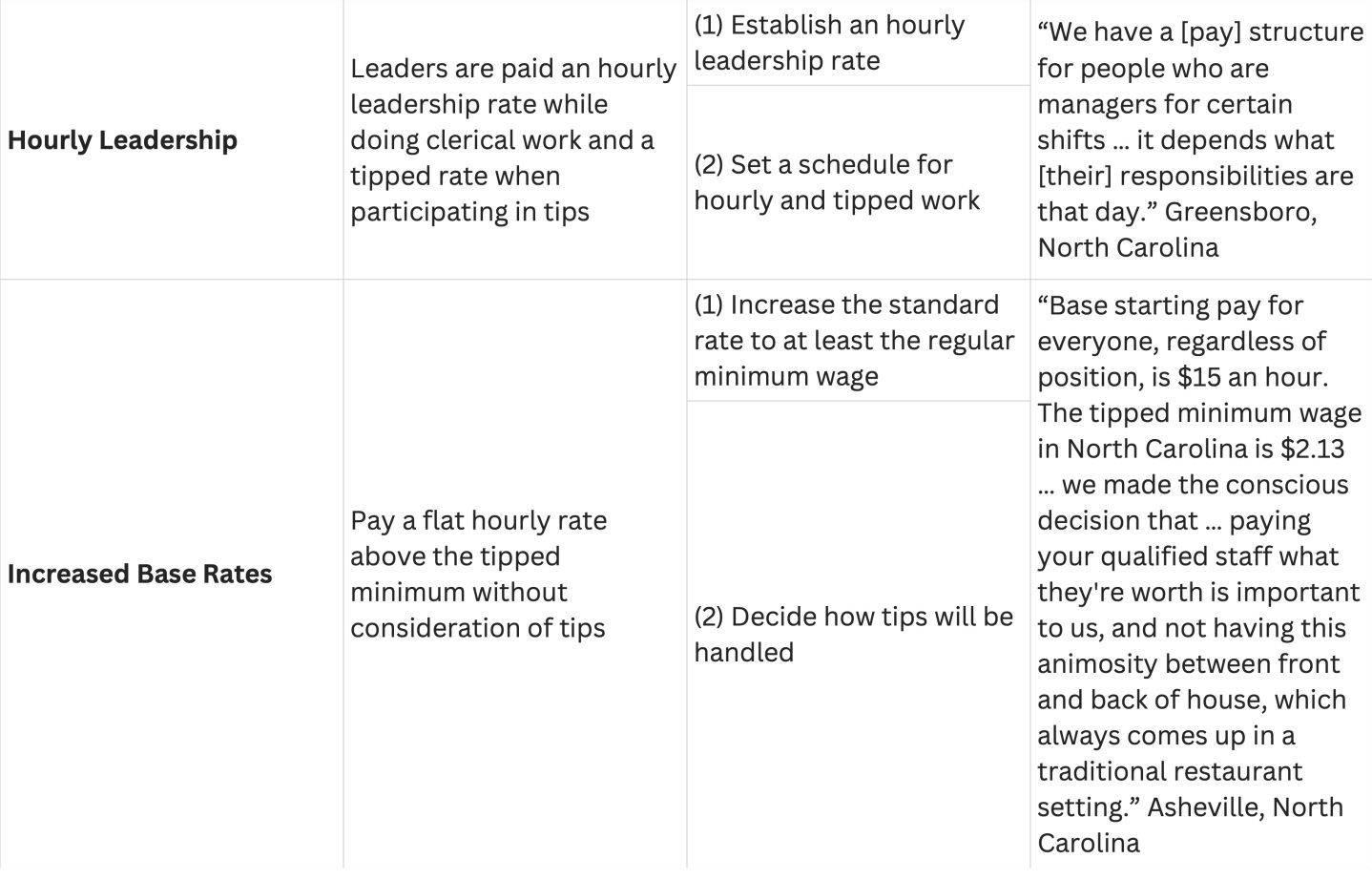
Table 2: From Beyond the tip credit: Modernizing business models for equitable wage practices
What’s Next?
The research conducted by the Tales of the Cocktail Foundation shows that for so many people, working in hospitality is not just a means to an end—it’s a satisfying, fruitful career that brings a lot of value to communities everywhere. But the system needs to evolve with the times in a way that supports both ownership and employee, which will in turn, benefit the industry as a whole.
“We hope to upset the paradigm that there is NOT a solution,” explains Wayner. “We argue that it’s not impossible to change the system, despite the many challenges, and that there are ways for bars and restaurants to offer more comprehensive benefits and wage packages to their employees while remaining profitable, and retaining top talent.”
From here, TOTCF acknowledges the need for further research into hospitality labor standards, so they can eventually provide more real solutions for supporting small businesses in a variety of states and different scenarios. To begin, the organization has launched a Bar Professional Policy Network, where resources on healthcare access and benefits, sexual harassment training, and youth worker engagement will be available. The organization has also joined the MORE Coalition, which brings together a number of industry institutions (including Another Round Another Rally, Independent Restaurant Coalition, and the James Beard Foundation) to push for economic mobility and workplace protections.
Finally, TOTCF is asking owners, bartenders, servers, industry professionals, major spirits brands, think-tanks, legislative bodies, and the other hospitality professionals and organizations (such as the National Restaurant Association and the Independent Restaurant Coalition) to get involved in ways large and small. “Raising the federal subminimum wage of $2.13 is a long term goal that will most likely take years,” says Voisey. “In the meantime, we believe instituting real and lasting change will start from the ground up.” 
Tales of the Cocktail Foundation conducted a first-of-its-kind research study with Bar Owners and Bartenders. Read the research article, “Beyond the tip credit: Modernizing business models for equitable wage practices,” written by Micheelle Russen, Lisa Nicole Cain, and Miranda Kitterlin-Lynch, in partnership with the Jack H. Brown College of Business and Public Administration, California State University, and the Chaplin School of Hospitality and Tourism Management, Florida International University, published in the Journal of Hospitality and Tourism Management.